Avgri Animal Feeds v Noomsa (2024) – What the Landmark Ruling Means for Trade‑Union Representation in South Africa
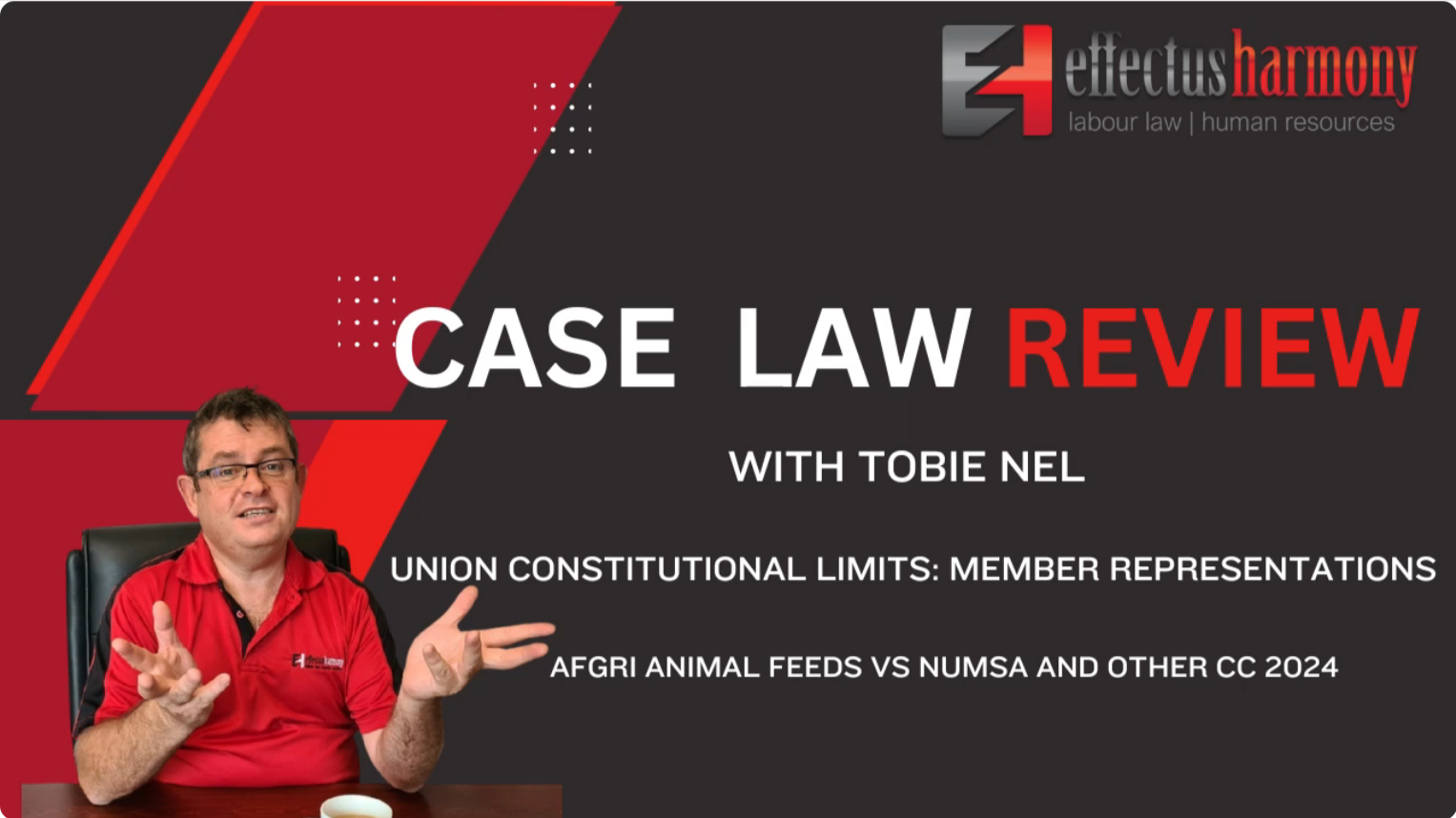
Welcome, Effectus Harmony followers, and welcome to this week’s case law review. Today we’ll be looking at Avgri Animal Feeds versus Noomsa and others that was decided on in June 2024, fairly recently.
This case law deals with the question of can trade unions organize and or represent employees at dispute resolution forums like the CCMA, the Bargain Council or the Labour Court, if their members are falling outside the scope of their constitution.
Understanding Trade Union Membership and Constitutional Scope
What Does the Labour Relations Act Say About Union Membership?
Now, for those of you who may not know, an employee in terms of section 4 of the Labor Relations Act that deals with freedom of association, they have the right to join a trade union and become a member of the trade union, subject to that union’s constitution. Now, section 95 of the Labor Relations Act deals with the registration of trade unions and employers organisation with the Department of Labor.
One of the key elements that a trade union must demonstrate in terms of section 95(5)(b) are the prescribed qualifications for and admission to membership. In other words, within the scope of a constitution of a trade union and employers organisations, it must demonstrate in which industries that trade union intends to collectively bargain and organise in.
Key Requirements for Trade Union Registration
When a trade union registers, it must clearly define:
- The industries it will represent
- Membership qualifications and admission criteria
- The scope of collective bargaining authority
- Territorial limitations for organization
So this is part of the prescribed qualifications of how do you join this union. As already stated, in terms of section 4 of the Labour Relations Act, an employee can only join a trade union subject to the constitution of that union.
The Practical Problem: Unions Representing Out-of-Scope Members
How Are Unions Operating Outside Their Scope?
Now, what’s happening practically in dispute resolution forums is that unions will pitch up and represent employees, maybe at the CCMA in arbitration, bargaining councils, or labour court applications. But the members of the union do not necessarily fall within the registered scope of that trade union.
This has been a contentious issue going through the courts in the Avgri Animal Feeds case for a number of years.
The Avgri Animal Feeds Case: A Step-by-Step Breakdown
Step 1: Labour Court Decision
The matter first went to the Labour Court. The Labour Court found that at the end of the day, a union can only organise or represent members within territories that fall under the scope of their constitution. If their scope does not allow them to organise in a certain industry, then they cannot organise for collective bargaining purposes or represent members at the CCMA, bargaining councils, or Labour Court, because they are bound by their constitution and limited to the authority prescribed in it.
Step 2: The Constitutional Complication
However, the issue became contentious because of section 161(1)(c) of the Labour Relations Act, which deals with representation before the Labour Court. It provides that a party may appear in person or be represented by, among others, any office bearer or official of that party’s trade union. This section does not explicitly refer to the scope of the union’s constitution.
The Labour Court maintained that unions are still subject to their constitutional scope. But this decision was overturned by the Labour Appeal Court, which held that an employee has the right to elect their own representative in dispute proceedings.
Step 3: Section 200 Argument
This view is also supported by section 200 of the Labour Relations Act, which provides that a registered trade union may act in its own interest, on behalf of its members, or in the interest of its members in a dispute. From this perspective, it appeared that the only requirement was that the employee be a member of the trade union.
NUMSA argued that they therefore had locus standi to represent their members in arbitration and Labour Court proceedings, even though they accepted that they could not collectively bargain or seek organisational rights outside their constitutional scope.
Step 4: Constitutional Court Final Ruling
The matter then went to the Constitutional Court, which settled the issue. The Court confirmed that a union cannot exceed its powers or operate outside the scope of its constitution. It rejected the idea that a union could represent members in disputes but not bargain for them.
What the Constitutional Court Decided
The Ruling: No Selective Membership Benefits
The Court held that membership cannot be selective in terms of benefits. A union cannot allow employees to join and then only extend certain rights to them. If the union’s constitution does not cover a particular industry, then the union cannot organise, collectively bargain, or represent employees in that industry.
The Legal Principle
The Court emphasised that this is not a question of fairness or access to justice, but a matter of legal authority. Section 4 allows employees to join unions, but only within the limits of the union’s constitution.
Key Implications for Employers
What Employers Need to Do Now
This ruling has significant implications. Employers should request and review a trade union’s constitution and confirm whether their industry falls within its registered scope. If it does not, the union does not have the right to organise, bargain, or represent employees within that business.
Action steps for employers:
- Request copies of union constitutions from any unions operating in your workplace
- Verify the registered scope and industries covered
- Confirm your industry is explicitly listed
- Challenge representation if the union operates outside their scope
- Document all union activities for compliance purposes
Key Takeaways
- Trade unions are legally bound by the scope defined in their constitution
- Unions cannot selectively extend rights to members—if they represent in one capacity, they must be authorized across all capacities
- Section 4 of the Labour Relations Act permits union membership only within constitutional limits
- The Constitutional Court rejected the distinction between dispute representation and collective bargaining authority
- Employers have the right to verify union constitutional scope and challenge unauthorized representation
- This ruling applies to all dispute resolution forums: CCMA, Bargaining Councils, and the Labour Court
Stay Informed on Labour Law Updates
Understanding these landmark rulings is crucial for both employers and employees. The Avgri Animal Feeds decision clarifies the boundaries of union authority and protects businesses from unauthorized representation claims.