Section 197 & Section 187 Transfers: What the Africa Online vs Echo International Case Teaches Employers
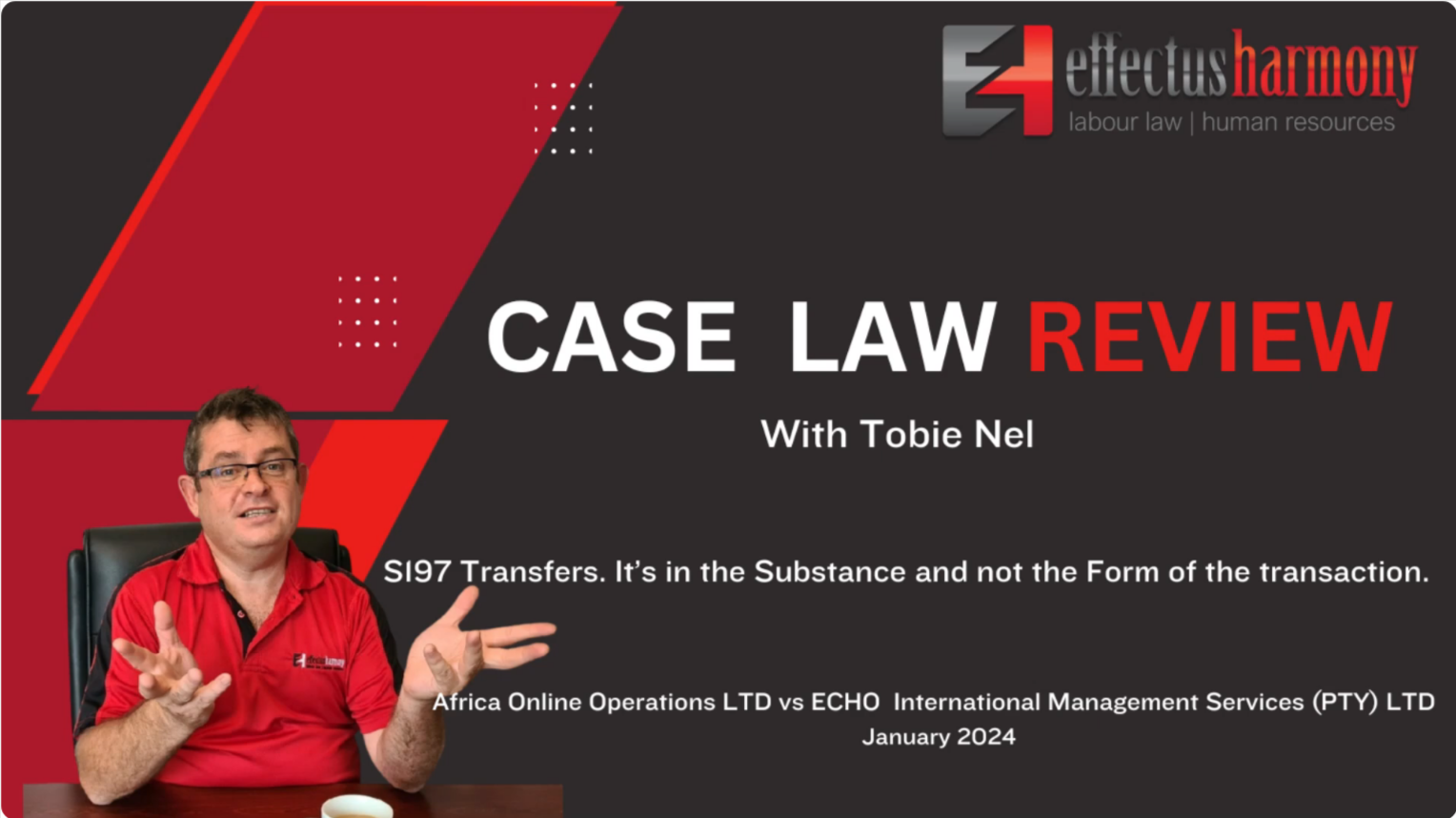
Welcome, Effectus Harmony followers, and welcome to this week’s edition of Case Law Review. Today, we are looking at transfers of businesses as a going concern in terms of section 197 of the Labour Relations Act.
Understanding Section 197 Transfers: A Critical Guide for Employers
We are not going to deal with a broad spectrum of what constitutes a transfer of a business as a going concern, as there’s a lot that can actually be discussed, said and debated about this whole concept.
Keeping in mind that this is a bit of a challenging concept in law, as companies are often confronted with when there’s a merger, for instance, or when a company wants to buy over another company or where there’s a cancellation of the services of one service provider and there’s a new tender out and another company comes in, does that engagement or transaction now constitute or fall within the ambit of a section 197 transfer?
This concept can be costly if you get it wrong. A lot of legal advisors, attorneys, IR practitioners, managers and CEOs will have sleepless nights trying to contemplate whether the nature and the form of a certain transaction fall within the ambit of a section 197 transfer or not.
The Africa Online vs Echo International Case: What You Need to Know
So we’re not going to completely delve into the full detail, but we are going to look at Africa Online versus Echo International. It’s a very recent Labour Appeal Court case from January 2024. Appeal to the Constitutional Court was denied, so this appears to be the end of the matter.
The Legal Framework Explained
Let’s first look at the legal framework. According to section 197 of the Labour Relations Act:
- A business includes the whole or part of any business, trade, undertaking or service
- A transfer means the transfer of a business by one employer to another as a going concern
- A “going concern” means elements of the business continue and survive the transaction
Even a service component can fall within section 197, making this definition broader than many employers realize.
What Happened in the Africa Online vs Echo International Case?
In this case, Echo International provided support services to the Gondwana group, including:
- Financial services
- Legal services
- HR services
- Payroll services
- Marketing services
- Operations services
The group decided to decentralise these functions so each business unit would manage its own support services. Echo International was liquidated, and Africa International took over some of the services.
The dispute arose because the board argued there was no section 197 transfer. Their reasoning focused on:
- No sale occurred
- No exchange of money took place
- No formal transfer document existed
- No resolution confirming transfer of rights and obligations
The board’s error: They focused on form rather than substance.
How Does Labour Law View Form vs. Substance?
Labour law applies the principle of substance over form. The same principle used in distinguishing employees from independent contractors applies here. Courts will look beyond the paperwork and formal structures to determine what actually happened.
The court examined the substance of the transaction:
- The directors of both entities were the same
- Some employees were re-employed or contracted by the new entity
- Systems and platforms (e.g. CRM) were transferred
- Services continued as before
- A communication to the group stated that although Echo was liquidated, it would be “business as usual” and services would continue under Africa International
The court’s findings:
- A transfer does not require a sale or payment
- A transfer can occur through restructuring, mergers, or service continuation
- The mode of transfer is irrelevant
- Substance takes precedence over form
Because the service, systems, and parts of the workforce continued, this constituted a transfer of a business as a going concern.
The Outcome and Impact
All 14 employees had to be reinstated with back pay and interest.
This case serves as a stark reminder that employers cannot avoid Section 197 obligations simply by avoiding formal transaction structures.
How Can Employers Assess Whether a Transaction is a Section 197 Transfer?
Use this practical checklist to determine if your transaction may trigger Section 197 protections:
Step 1: Identify What’s Continuing
- Are services continuing under new management?
- Are systems, equipment, or assets being transferred?
- Are any employees being re-engaged?
Step 2: Look Beyond the Form
- Does it matter if there’s no formal agreement?
- Does it matter if no money changed hands?
- Does it matter if one company was liquidated?
- Answer to all: NO – Form is irrelevant if substance shows continuity
Step 3: Assess the Workforce
- Are the same people doing the same work?
- Are they doing it for the same clients/group?
- Are they using the same systems?
Step 4: Document Your Analysis
- If you answer YES to most questions above, Section 197 likely applies
- Consult with an employment law specialist before proceeding
- Document your reasoning in case of future disputes
Step 5: Ensure Compliance
- Notify affected employees of any changes
- Ensure continuity of terms and conditions where applicable
- Maintain records of your assessment
Key Takeaways for Employers
- Do not rely on the absence of a formal transaction or payment. Assess what actually continues in substance—services, staff, systems, and operations. If these remain, section 197 is likely triggered.
- Substance always trumps form. The courts will look at what actually happened, not what the paperwork says happened.
- Restructuring, mergers, and service continuations can all trigger Section 197. The method of transfer is irrelevant.
- The costs of getting it wrong are significant. Reinstatement, back pay, and interest can amount to substantial liability.
- Seek professional advice early. Before implementing any business restructuring, consult with employment law specialists.
Don’t Leave Section 197 Compliance to Chance
The Africa Online vs Echo International case demonstrates that courts will not accept form-based arguments when substance shows a business transfer. Whether you’re restructuring, decentralizing, merging, or changing service providers, the principle is clear: if the business continues in substance, Section 197 protections apply.
Ready to ensure your business restructuring is compliant? Contact Effectus Harmony today for a professional assessment of your transaction. Our employment law specialists can help you navigate Section 197 requirements and protect your organization from costly disputes.
Don’t wait until it’s too late—get expert guidance before you restructure.
Have questions about how Section 197 might apply to your specific situation? Reach out to our team of employment law specialists for a confidential consultation.